
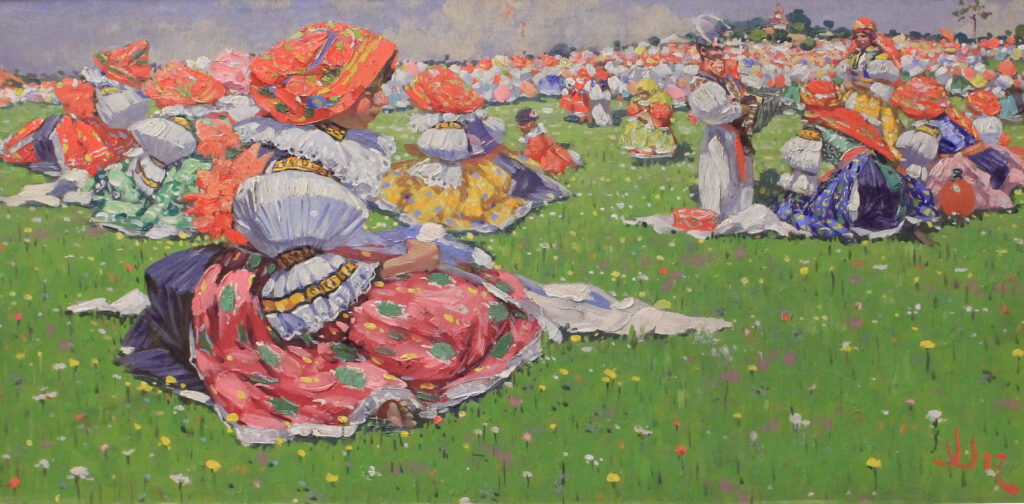
Joža Uprka, known for capturing the traditional garments worn by the Moravian people, consistently found the ideal opportunities to capture the festive costumes during the iconic St. Anthony’s pilgrimage. His 1894 depiction is arguably one of his most iconic.
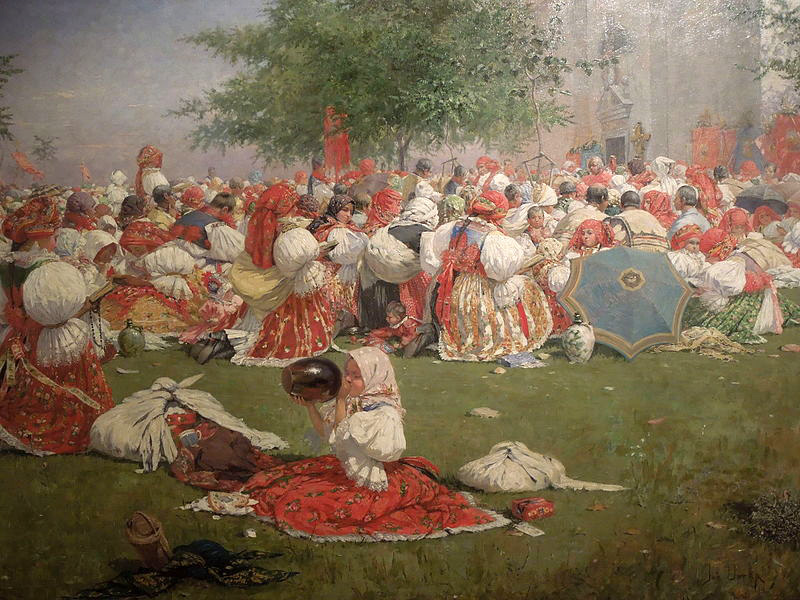
The scene (fig. 1) depicts a vast crowd gathered for the pilgrimage to Saint Anthony in Blatnice pod Svatým Antonínkem. On St. Anthony’s Hill, worshippers assemble before the Baroque chapel dedicated to the saint. Moravian pilgrims kneel in prayer while a few remain standing, all turned toward the church where a priest leads the service on a makeshift pulpit outside.
Despite the June heat, men and women are dressed in richly decorated kroje, each costume reflecting the distinct designs of the towns from which they have traveled. Women wear bright red headscarves, while the voluminous sleeves of their garments shield their shoulders from the summer sun. The starched fabric is hardly suited to the humidity, nor is it ideal for walking long distances or kneeling in the grass; yet, everyone has arrived in their Sunday best. Even the children in the foreground, playing in the grass, too young to focus on prayer, are dressed in festive folkloric attire.
Only one figure turns away from the ceremony entirely—a young girl at the front of the composition drinks from a jug of water, likely weary and parched from the long procession and the sunny day. Behind her, several children glance toward Uprka himself, curious about the painter who, unlike the other pilgrims, is absorbed in the canvas, devoted to capturing the scene before him. Respectful of the service unfolding before them, they nevertheless seem restless with anticipation for the festivities that await.
The Feast Day of Saint Anthony Padua was not solely a religious observance—it was also a joyous communal celebration. Positioned as an observer within the crowd, the viewer can almost hear the rustling leaves overhead, the priest’s voice carried away by the wind, and the occasional sharp whisper of mothers reminding their children to face forward; yet, against the still solemnity of the painted moment, the kroje speak with vibrant excitement. One source describes, “At that time, the noise and bustle on the hill fall silent. In a picturesque circle, devout pilgrims gather around the pulpit to hear the word of God. These are unforgettable moments, full of colorful beauty and variety. Nothing moves; only the breeze from the forest brings the scent of thyme and resin.”
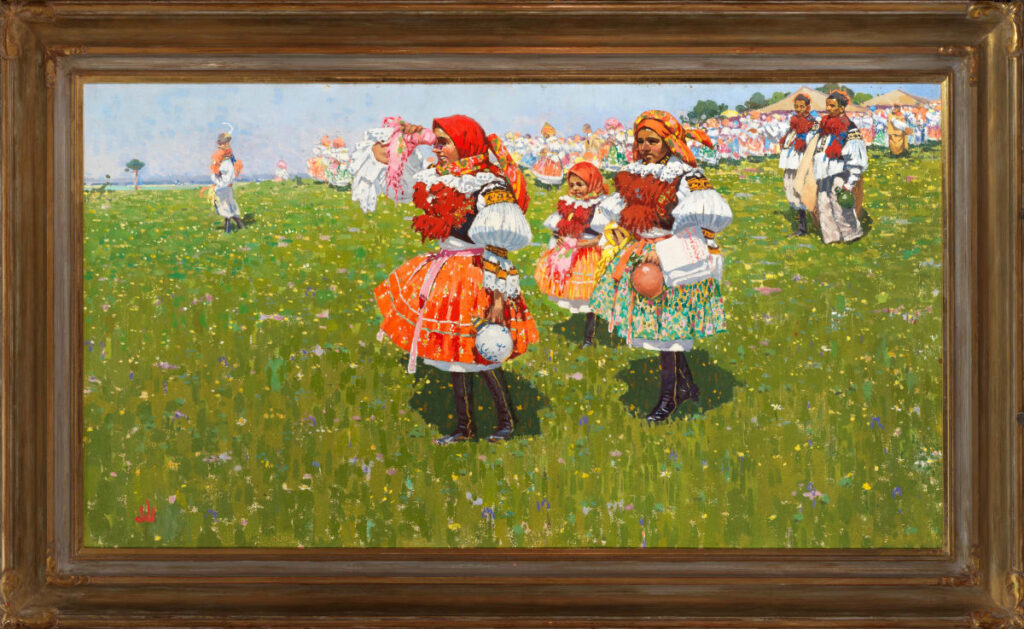
Their bright colors and detailed designs hint at the excitement that accompanied the day’s events. Along the road to the chapel, pilgrims sang together as they ascended the hill, anticipation filled the air for the festivities to follow. Beyond the religious service, the pilgrimage transformed the hillside into a lively gathering place. Small huts and stalls were erected near the church as seen in his The first version of the Vlcnov family on a pilgrimage to St. Anthony (fig. 2), offering gingerbread, produce, religious souvenirs, and handcrafted goods for sale. Families browsed the vendors, neighbors caught up with one another, and visitors from surrounding villages mingled throughout the grounds. For young men and women, the pilgrimage also presented a rare opportunity to socialize, exchanging flirtatious glances during the procession before meeting later amid music, dancing, and celebrations that continued in the town long after the Mass had ended.
The St. Anthony’s pilgrimage remains a yearly tradition today, though the sea of folk costumes that once defined the event has diminished considerably. Uprka’s artistic practice was motivated by a desire to preserve such fleeting moments, documenting Moravian customs and dress as industrialization and modernization gradually transformed rural life. There is a particular poignancy in his repeated depictions of Saint Anthony’s pilgrimage. As the patron saint of lost things, Saint Anthony becomes an especially fitting figure within Uprka’s work. Sensing that traditional ways of life were slowly disappearing, Uprka transformed his paintings into an archive of cultural memory—a representation of people, customs, and clothing that might otherwise have continued in oral tradition, but visually faded from collective remembrance.
In this sense, Uprka’s brush may be understood as a kind of prayer: a meditation on folk practice and community, an act of preservation intended to ensure that the memory of Moravia could never be entirely lost. It is perhaps no coincidence that he returned to this subject throughout his career. From his earliest studies of the pilgrimage to his later 1925 rendition exhibited in the 24th International Exhibition of Paintings at the Carnegie Institute, Uprka repeatedly recorded the people, costumes, and rituals that animated Saint Anthony’s Feast Day. Through these works, he not only documented a tradition but safeguarded it for future generations, ensuring that Moravians would always have a pathway back to their cultural roots.
While his 1894 depiction remains among some of his most celebrated works, he continued returning to Saint Anthony’s Hill throughout his career. In sketches and paintings produced over the following decades, his focus gradually shifts. He moves focus away from the massive crowd gathered around the priest, and hones-in on the intent of gathering: solitary pilgrims seated in reflection, women conversing in small groups, families making their way across the hillside—the experience of togetherness.
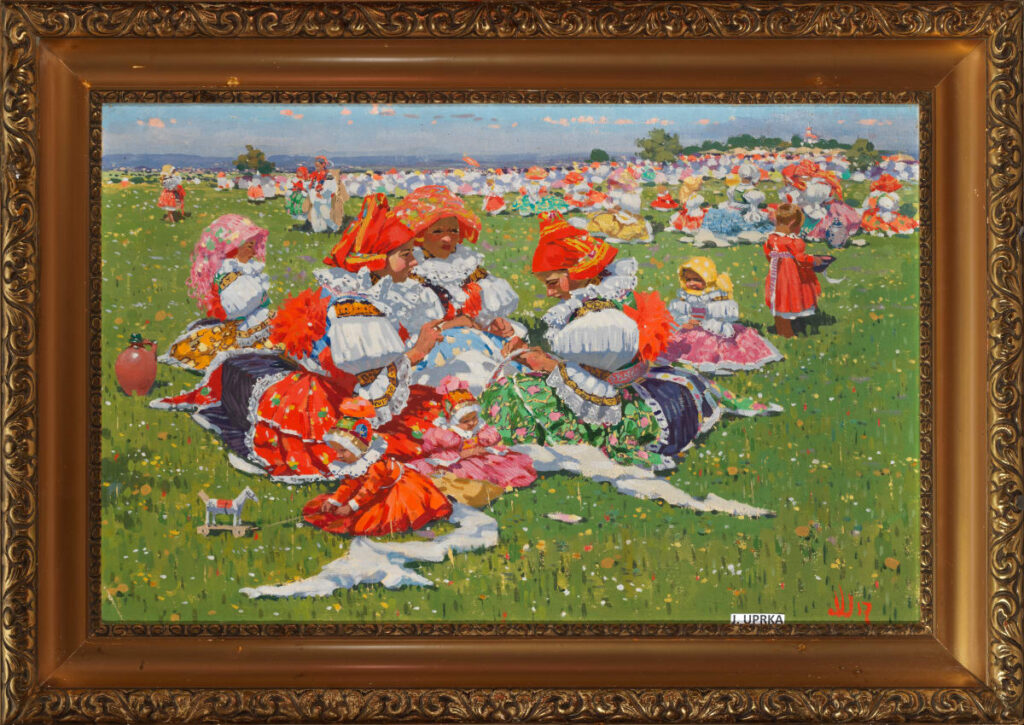
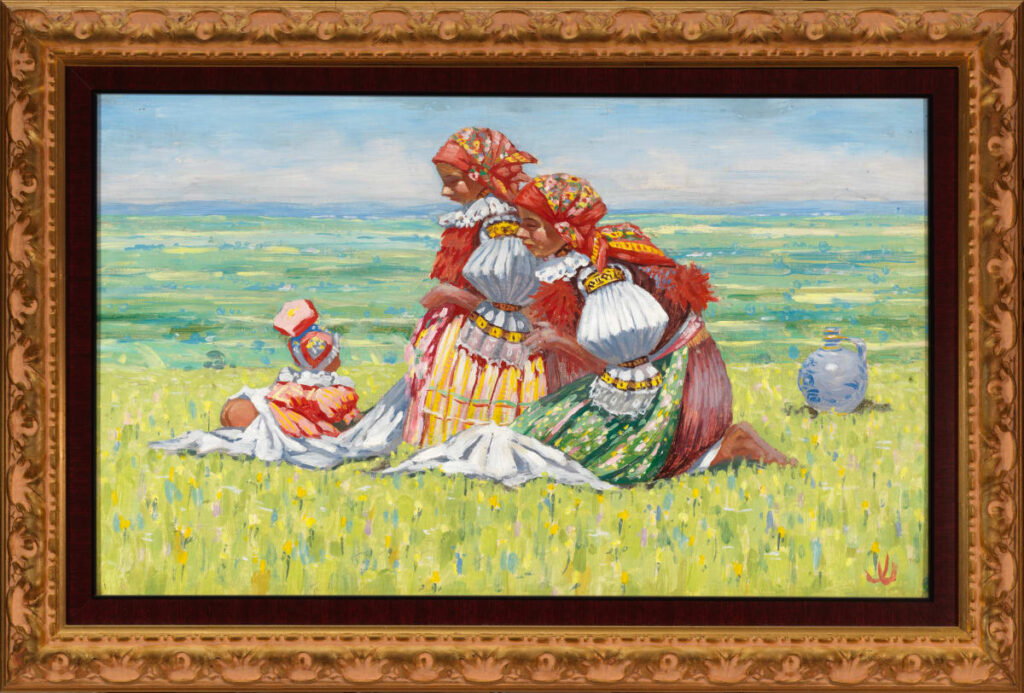
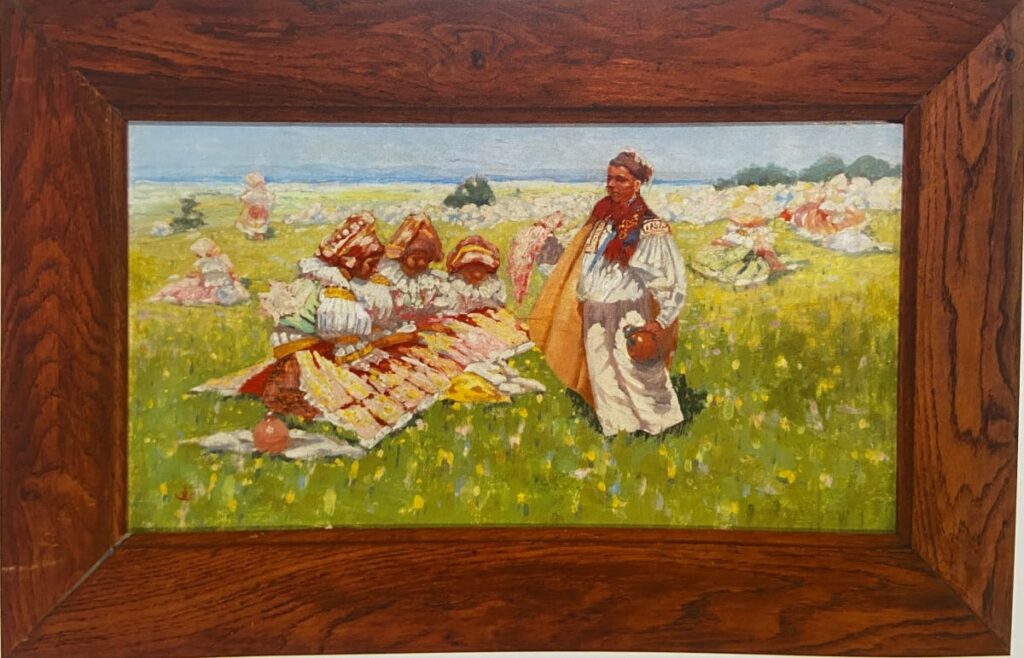
Uprka’s later depictions (fig. 3-5) act as a reminder that the pilgrimage was never solely a religious event, but a social one, a place where faith, community, and local customs could gather. The joy and anticipation visible in Uprka’s paintings are not confined to a single historical moment. While the appearance of the festival has changed and traditional kroj is no longer worn as commonly today, the pilgrimage continues to draw people together each year. The manner may evolve, however the impulse to collectively share in the act of celebration persists.
Perhaps, this is the enduring question raised by Uprka’s work. If folklore is not only a fixed collection of costumes, customs, or rituals, but a living expression of communal identity, how does it adapt as the world around it changes? At what point does a tradition become something new, and can it still remain recognizably connected to its origins?
There is no definitive answer, however, his paintings invite us to consider folklore as an ongoing tension between inheritance and change, one that continues as communities find new ways to gather, celebrate, and recognize themselves in one another.