
As of late, AI has been a hot topic—for many reasons, but particularly within the arts. This is not the first time that art has transformed in response to emerging technologies, nor is it the first moment in history when technological advancements have fundamentally reshaped the ways in which art is both created and consumed. When looking at the intersection of technology and art history, there is often an inclination to return to handicraft, to reassert the importance of human labor during moments marked by uncertainty and a perceived loss of control.
This return functions as a reassurance, a sense of comfort and stability, and a reminder that while emerging technologies may optimize production, they cannot think, interpret, or execute creativity in the same way that humans can.
The rise in handicraft today points to a broader pattern—the impulse to slow down in response to the rapid pace of progress and consumerism. The pioneer of the British Arts and Crafts movement, William Morris, famously reacted against industrialization, yet today we encounter an irony: objects that resemble his ideals are often produced through fast, mechanized processes, prioritizing the consumer over the creator.
This is because the issue is not only affordability, but a cycle of consumption, where objects are quickly acquired, discarded, and replaced in accordance with shifting trends.
It is precisely within this cycle that true handicraft is re-emerging. Carpathian rugs and products made from Ukrainian wool are returning to prominence, both as aesthetic objects and embodiments of time, labor, and cultural specificity. Labor-intensive, traditional modes of production are resurfacing as a means of reasserting material quality and perceived value, while continuing the cultural histories and practices inherently tied to these objects.
There is certainly an element of nostalgia at play. Returning to the past can feel easier, more stable, particularly when framed as a rediscovery of value. In an Instagram series led by Tomasz Szymański following elderly artisans throughout Poland, a Polish woman weaving on a loom remarks that “we are returning to the past because everything already exists,” suggesting that what we perceive as rediscovery is, in fact, a return. At the same time, this return operates as a form of appreciation, a recognition of practices, materials, and traditions that may not have been fully valued before.
Technological advancement, in this sense, heightens our awareness of loss—of the ways in which the past risks becoming obsolete—and reinforces the idea that memory, heritage, and tradition can be sustained through the hand, quite literally.
Joža Uprka’s work is emblematic of this kind of transition. The period in which Uprka was working was not unlike our own. Industrialization gradually reached rural regions of Czechoslovakia, transforming daily life through the availability of inexpensive, mass-produced clothing. While these garments were more practical and time-efficient than making clothes by hand, their rise contributed to the decline of the kroj, a traditional form of dress that moved from everyday use to more celebratory and special occasions. To claim that culture was disappearing entirely may be overstated, yet the shift was significant.
The kroj stood in direct opposition to industrial production: it was slow, deliberate, and highly detailed. Each embroidered motif, each woven pattern, required time and care, culminating in a garment that embodied cultural significance and the labor that stood behind it.
This process of making offered a different kind of gratification, one that unfolded gradually, against the mode of the immediacy of purchasing ready-made goods. At the same time, the kroj was not always practical, particularly for physical labor in the fields, which further contributed to its decline in everyday use.
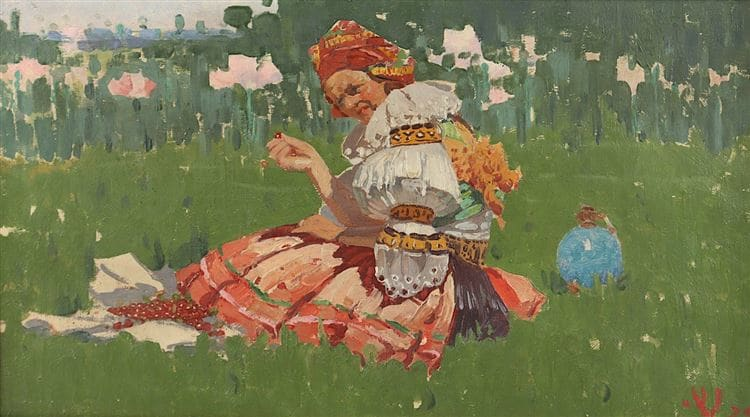
Uprka’s paintings function as both archive and romantic idealization. His depictions of Moravian folk costumes preserve visual records of these garments, yet they also present an idealized version of rural life. Many of the outfits depicted are ceremonial, “Sunday best” worn for festivals, pilgrimages, and communal events, rather than practical, everyday clothing. In this way, his work produces an image of cultural continuity that is, in part, constructed for both local and external audiences.
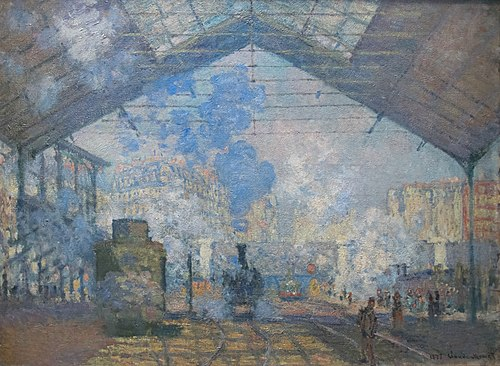
His painterly style reinforces this tension. Drawing from French Impressionism, Uprka employs loose, vibrant brushstrokes that capture fleeting moments rather than fixed details. Unlike Édouard Manet, who often depicted modern life and industrial transformation in tandem, Uprka turned toward traditional subject matter. This was a significant contrast—a modern technique used to preserve and elevate a pre-industrial way of life, positioning the folk subject as an ideal in the face of technological change.
This dynamic closely mirrors the present moment. AI operates by aggregating and synthesizing vast amounts of information, often reducing complex cultural forms into generalized outputs. If prompted to generate an image of a kroj, for example, it may produce a convincing result, but one that collapses regional distinctions into a single, inauthentic composite. Nuance is lost, and specificity is flattened.
It is perhaps for this reason that there is a renewed emphasis on the tactile. Although industrial production has dominated for over a century, AI has introduced a new kind of abstraction—one that intensifies the desire for work that is unmistakably human. Hand-spun materials, woven textiles, and other forms of craft rooted in tradition offer a counterpoint; they are slow, embodied, and context-specific.
At the same time, this return is not without complication. The rise of aesthetics such as cottagecore reflects a parallel tendency to romanticize tradition. Emerging prominently during the COVID-19 pandemic, cottagecore presented an idealized vision of rural life, one defined by simplicity, a return to nature, and self-sufficiency; yet, this vision often omits the labor, difficulty, and specificity that characterize actual rural living. Like Uprka’s paintings, it constructs an image that is as much about longing as it is about reality.
Still, these nostalgic impulses signal something important. They reflect a collective desire for slowness, intentionality, and connection in a time defined by speed and digital dependence. Uprka’s work responded to a world in transition by preserving what felt at risk of being lost.
In our current moment, however, the question becomes less straightforward. Against the backdrop of AI and accelerating technological change, what exactly do we desire to return to? What traditions are we seeking to preserve—and are they past, lived realities, or constructed, romantic ideals?

Ivanka Suska
suska.ivanka@gmail.com