
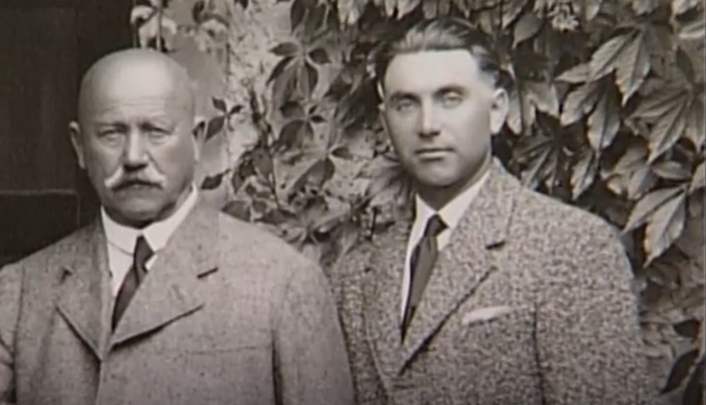
Despite following in his father’s artistic footsteps, Jan Uprka is unfortunately known for his involvement in a much more controversial career—participating in the fascist party during the occupation of Czechoslovakia. While his father, Joža Uprka, became internationally celebrated for his depictions of Moravian folk life, Jan never achieved comparable artistic recognition. Living in the shadow of his acclaimed father could have contributed to his desire to establish a new path for himself, but still participate within the Moravian life he knew and loved. Politics promised cultural relevance, advocated for regional autonomy, and likely fulfilled a feeling of personal authority for Jan.
In the late 1930s, Jan Uprka’s public life became increasingly defined by politics rather than art. He became a founding member of the National Fascist Community and later assumed a leading role in Národopisná Morava, or Ethnographic Moravia, an organization originally chaired by his father.
During the German occupation, Uprka emerged as an advocate for the annexation of the Slovácko region, and other parts of eastern Moravia to the newly independent Slovak State. This initiative was rooted in nationalist arguments that drew on the romanticized legacy of the Great Moravian Empire (1). Even the Slovak government supported the movement, seeing it as an opportunity to reclaim land and populations lost during earlier Hungarian annexations. It helped that the spoken dialect, religion, and folkloric traditions were similar to that of eastern Slovakia, which bordered Slovácko.
This cultural affinity however, was misused for political ends. The few Moravian fascist activists, including those of Národopisná Morava, frequently attended religious celebrations and cultural events to exploit the masses to join the cause (2). Folk culture was weaponized as proof of ethnic unity, and thus, political legitimacy.
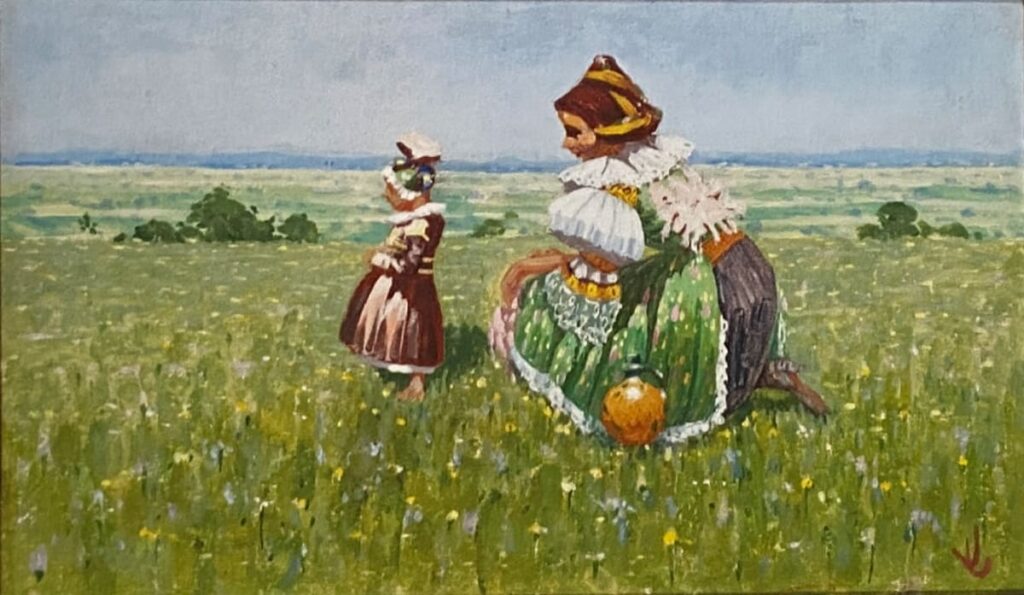
Residents of Moravia were ultimately unconvinced, and even German authorities never seriously considered the annexation. Their real goal was to Germanize the occupied Czech lands as a link between Germany and Vienna, and the Slovacko annexation would have hindered those plans. Initial tolerance of the Moravian separatist movement was generally supported by German officials as it fostered dissent and weakened Czech unity, meaning the support shown towards Národopisná Morava and the Slovak government backing their plans was only an illusion. By 1940, openly separatist figures had lost influence within the organization, which shifted toward formal loyalty to the Protectorate of Bohemia and Moravia (3). Jan Uprka himself eventually realized that annexation was unrealistic.
Despite holding the role of chairman of Národopisná Morava, Uprka realistically exercised little real power. With no formal education and limited political awareness, he proved unable to navigate the complexities of his role. He was said to be influenced by figures who appeared to be collaborators or double agents, acting in the interest of multiple sides.
This meant that Uprka functioned as a symbolic figurehead, mainly useful to others because of his family name. In one instance, he attempted to recruit support by signing a document as “J. Uprka,” purposely capitalizing on the ambiguity between his and his father’s name, in order to give his political initiatives greater legitimacy (4). In reality, Joža disagreed with his son’s political affiliations.
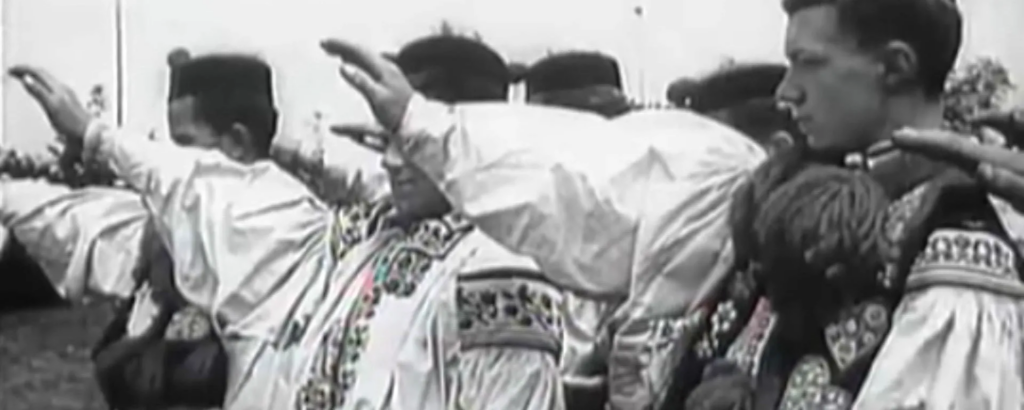
Jan’s wartime conduct showed distinct moral implications, however. At times, Národopisná Morava adopted openly anti-Semitic rhetoric, including calls to remove Jewish residents—despite the region’s relatively small Jewish population, estimated at approximately 5,000 people (5). There is no evidence, however, that Uprka ever denounced anyone to German authorities. On the contrary, multiple documented cases attest to his direct intervention on behalf of persecuted individuals.
He helped save the Roma musician Jožka Kubík and members of the Kubík and Kýr families from deportation to concentration camps. During a period in which roughly 90 percent of Moravian Roma were targeted and murdered in concentration camps (6), these individuals survived—partly because their mastery of regional folk songs rendered them culturally “valuable” within the very system that sought their eradication.
In this sense, their survival also reflects a deeper truth; despite racial persecution, Roma musicians were, in practice and tradition, part of Moravian cultural life and its customs.
Uprka also aided individuals escaping forced labor transports to Germany, including a woman who fled a deportation train and faced severe punishment if recaptured. Notably, no one from Uprka’s hometown of Hroznová Lhota was arrested or executed during the war.
He further protected cultural heritage by hiding his father’s paintings after an order was issued to transfer them to the Reich as confiscated property.
After World War II, Jan Uprka was arrested, his property confiscated, and he was put on trial for collaboration with the German occupying power. The proceedings revealed both the breadth of his political involvement and the limits of his culpability. Although his affiliations with Nazi-aligned organizations were undeniable, evidence showed that he had never informed on anyone and had repeatedly acted to protect those at risk.
Ultimately, Uprka was deemed legally irresponsible for his actions and declared insane. He lost faith in the Germans and was, in many respects, discarded by the very system he had once believed might advance Moravian autonomy. Some historians have described him as a scapegoat—useful to Nazi authorities as a symbolic figure, but ultimately expendable.
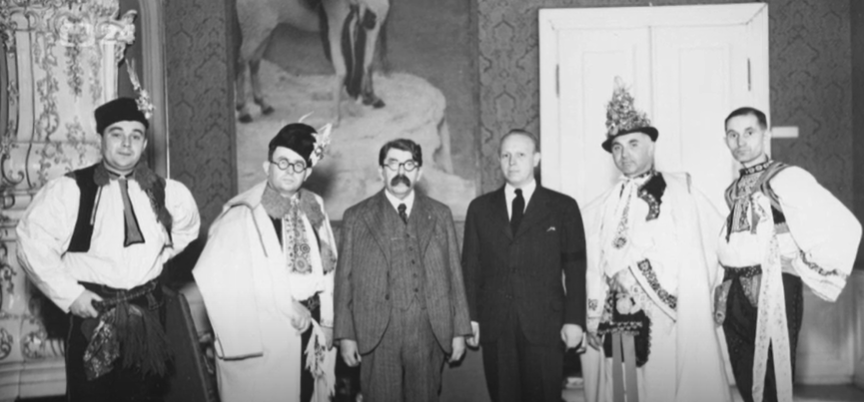
Uprka’s life remains morally complex. His political choices were shaped by nationalist illusion, personal ambition, and ultimately, political naïveté.
He was entangled with institutions that enabled widespread harm; yet, he also demonstrated moments of courage, compassion, and resistance toward communities facing persecution. This underscores why it remains essential to preserve and amplify the histories of those most affected by such regimes.
The Festival of Everlasting Hope embodies this commitment today. Founded to preserve and further develop the cultural heritage of Central Europe, the festival centers on music violently silenced during World War II. While figures such as Jožka Kubík survived in part due to individual acts of protection, many others were not so fortunate. Artists imprisoned in camps such as Terezín created music under conditions of extreme oppression, even as their lives were at risk.
Their compositions stand as evidence of creative and moral agency within systems designed to erase both people and culture. Honoring these artists ensures that voices silenced by violence continue to be heard by new generations, and affirms that art can endure even when politics resort to brutality.
Focusing on Jan Uprka’s legacy is not an attempt at redemption. Rather, it invites reflection on how easily culture can be weaponized, the dangers of nationalist mythmaking, and the enduring importance of individual acts of humanity. His story reminds us that even flawed and politically misguided individuals can, at critical moments, choose to protect others—and that such choices, however limited, still matter.
(1) Mareš, Miroslav. 2013. “Separatist Currents in Moravian Fascism and National Socialism.” Fascism 2. https://doi.org/10.1163/22116257-00201010.
(2) ČT24. 2018. “Historie.cs: Slovácko Sa Nesúdí, Ale Odtrhává.” https://www.ceskatelevize.cz/porady/10150778447-historie-cs/318281381940009/.
(3) Mareš, 2013
(4) ČT24, 2018
(5) Mareš, 2013
(6) “Jožka Kubík: Hrubá Vrbka.” 2026. Hrubavrbka.cz. 2026. https://www.hrubavrbka.cz/jozka-kubik/d-1006.

Ivanka Suska
suska.ivanka@gmail.com