Early criticism of Joža Uprka often focused on his remarkable technical skill and keen eye for visual detail, qualities that led some critics to describe him as a “painter of surfaces.” While his works were praised for their precise observation of color, texture, and form, Uprka’s great-grandson, Jan Benedik, arges that the emotional depth viewers sometimes perceive in his paintings is often projected by the viewer themselves, rather than intentionally depicted by the artist. Below, Benedik reflects on this critique and offers his own thoughts on the artist’s intentions and legacy.
Joža Uprka is a painter of surfaces. For this he has a well-trained eye and a highly developed technique. The life of the people of Slovácko, among whom he lives, however, escapes him.
His people are without will, without a spark of temperament. Nowhere does passion hiss, nowhere does defiance strike. Everything in his work is smiling, chaste, harmonious, balanced.
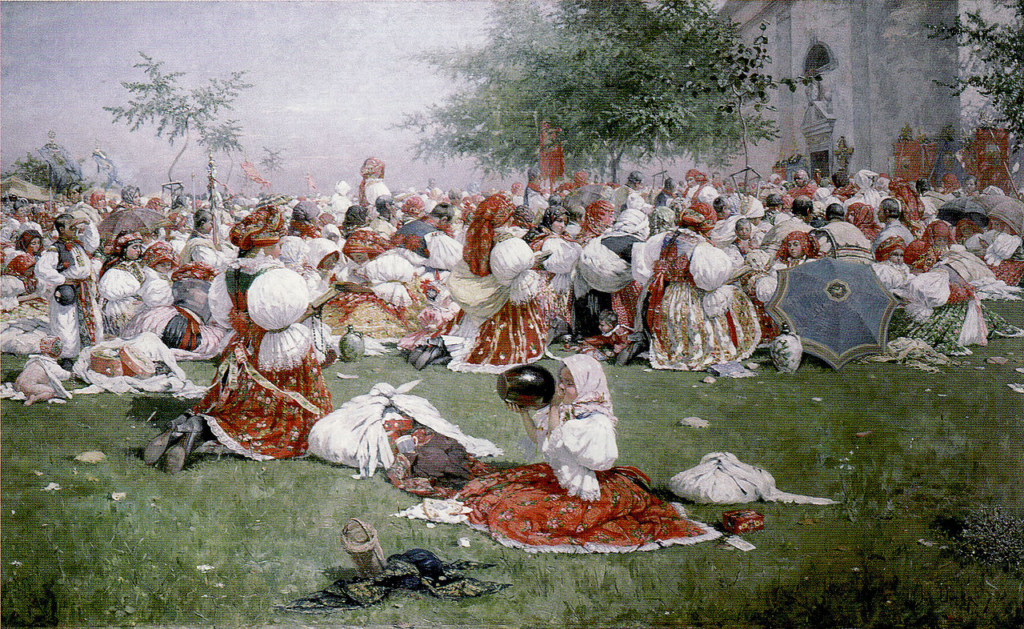
1894, oil on canvas, 90.5 x 151 cm, Moravian Gallery, Brno
Moravian Life According to Mr. Uprka
How well Mr. Uprka can capture surfaces is best demonstrated by his favorite Pilgrimage to St. Anthony (fig. 1). The clay vessel in the foreground is painted with truly touching love.
The observation of the refracted reflections of green and red on the brown glaze is almost comically surprising.
The painter captured the kneeling crowd in blazing red with great skill, but he forgot that these people are also supposed to pray.
And here, precisely, where the craftsmanship of the craftsman ends and where art begins, here, where the real artistic problem is to be solved: to catch something that a more trained eye is not enough for, here, where psychic elements, ecstasy and mysticism of prayer have to spill life into the stiffly kneeling crowd — here, at that point, Mr. Uprka suddenly stops; he cannot cross it.
And this fatal boundary between virtuosity and art is noticeable in all his works. It is also said that Mr. Uprka is sometimes moody. This is again a flattering, unintentional lie.
According to the line of his development, Mr. Uprka simply cannot be one. It has never even occurred to him to be moody. And how is it that some of his paintings have a moody effect on you?
Because the viewer puts into them what is not in them. Mr. Uprka certainly paints as much as he sees with his keen eye.
And then a similar process occurs with the viewer, as if he were standing in front of a real landscape, inserting into it the whim of his soul, that which is actually not in it de facto…And with what horrible antiquities he has come up with under Mr. Uprka with a tendency towards modernity!
Millet, Courbet, Liebermann!
How far they are above them elsewhere!
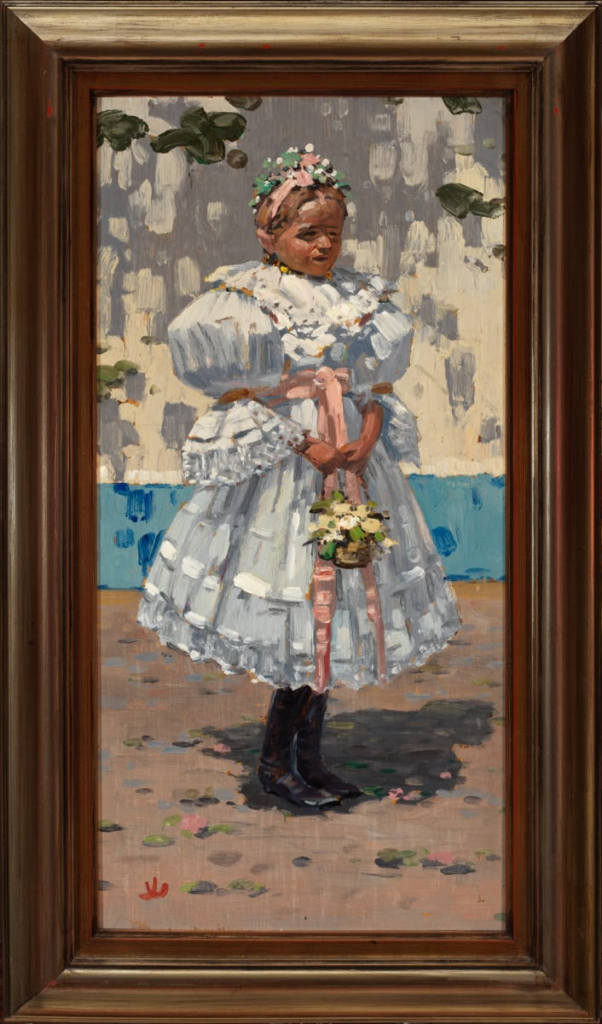
Uprka’s painting work was subjected to criticism from the very beginning, which was not always in the artist’s favor. During his student years, it took the form of supporting young talent, and we encounter practically no significant controversy.
Zlatá Praha or Světozor, the most famous art magazines in Bohemia, published reproductions of his pen drawings several times, and in the final year of his studies at the Prague Academy of Painting in the master class of Maxmilián Pirner, he even published an oil painting, Malérečky (1888).
The situation naturally changes when Uprka tries to rank among professional artists and establish himself on the domestic art scene, and when his concept of the Slovak countryside also changes towards a realistic capture of the sometimes harsh reality of the Moravian-Slovak borderland.
Gradually, he abandons the aesthetic criteria instilled by academic education and the bourgeois environment, thus coming into conflict with more conservative art criticism and the collecting community, still influenced by the romantic myth of the Czech countryside in the work of Josef Mánes.
His complete ignorance of the realities of Moravian Slovakia also plays a role here, and thus the poor comparison between reality and the world depicted in Uprka’s paintings.