
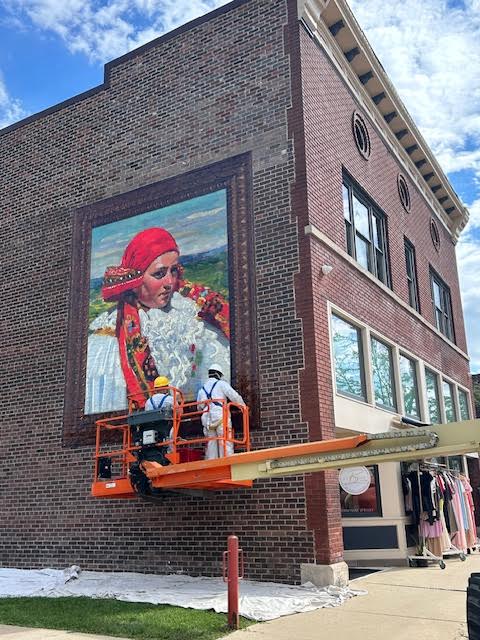
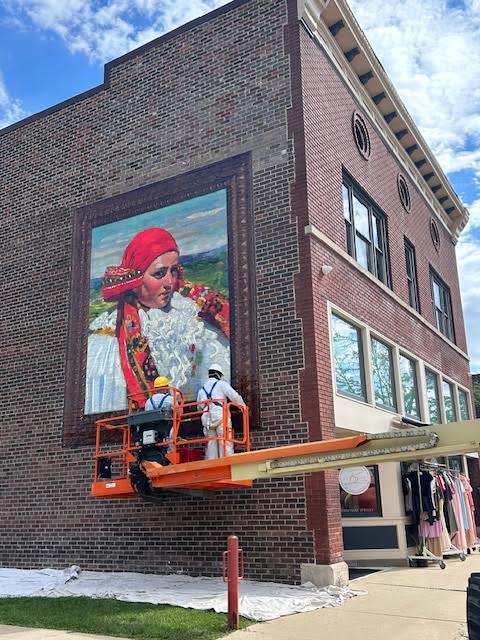
Located in the Czech village district of Cedar Rapids, Iowa, the mural was made possible through the Self-Supported Municipal Improvements District (SSMID), a program through which local businesses contribute additional funds to beautify the neighborhood through public art and cultural initiatives. Moravian Madonna not only enriches the aesthetic profile of New Bohemia, it reasserts a historic heritage woven into the city’s identity.
Turning the corner of 16th Ave SW and C St. SW lives the portrait of Joža Uprka’s Moravian Madonna, adding a bit of heritage, cultural emphasis, and artistic vision beyond its original canvas into a diasporic community thousands of miles from its point of origin.
George T. Drost, the original owner of the painting shared with CBS42: “Uprka’s art is about identity, faith, and tradition–and bringing this masterpiece into the heart of the community is a way of sharing Moravian culture with everyone, not just museum visitors.”
This sentiment particularly impactful, since the piece itself looks as though it could have escaped the museum—the young Moravian girl, her red scarf vivid against the brick wall on the east side of the Kosak building, appears almost to have slipped out of the museum and taken up residence in the neighborhood.
The mural was transferred onto the brick with PolyTab, a mural cloth produced from a high-resolution scan of the original painting.
Installers adhere the work to surfaces with acrylic gel, and with a final varnish, the work is safely sealed onto its given surface.
This process was especially crucial in realizing another SSMID-commissioned project—a pair of murals by Columbian artist Nathalia Gallego Sanchez, better known as Gleo, who was denied entry into the United States.
Internationally known for her large-scale murals, Gleo was unable to paint the commission herself due to visa restrictions. Rather than scrap the project altogether, On View gallery owner Ben Hurn sought the help of Mural Provisions to collaborate with Gleo, and design a PolyTab wallpaper to apply to the building. Mural Provision’s owner Ben Volta explains that the PolyTab functions “like a sheet of primer, so it breathes like paint with little fibers holding it together. When moisture goes into the wall, it goes in the same way. Paint is always breathing.”
In Uprka’s original painting located in Czech village, the Madonna is situated within the bright green landscape of her native Moravia, her gaze looking past the viewer toward her homeland. Now in Cedar Rapids, the woman finds a new life looking across a landscape inhabited by the descendants of immigrants who brought her culture across an ocean.
Read More: Notes from a Collector: George Drost on the Life and Work of Joža Uprka
Located just an eleven minute walk from the Uprka, Gelo’s murals reside on the Fulton Lofts buildings across the Cedar River. Her first mural features vibrant orange blossoms set against yellow-green leaves, and framed by pale yellow lavender borders. The second scales the entire side of the building, echoing a similar color scheme to the first, but incorporating the same orange flowers within the outline of a woman.
With her profile turned gently to the side, and similarly to the Madonna, she looks beyond the viewer; however, unlike Uprka’s figure, who wears a regional kroj that represents the land she comes from, Gleo’s appears composed entirely from the land itself. Both artists show that the figures are shaped by the environments that sustain them.
Together, the murals explore how land shapes identity, and how figures, within the surface of a canvas or outside of it, can traverse both time and borders. Despite Gleo’s denied entry, the collaboration forged between the artist and city demonstrates a commitment to cultural connection.
Commenting on her work for The Gazette, she expresses: “I don’t know Iowa…but I feel like we’ve built a bridge where we belong and are closer despite our differences and distance. The murals are an embodiment of those efforts to find each other and communicate.”
This echoes the heritage embedded in Uprka’s Moravian Madonna along Czech village, even as each Polytab work engages with borders differently—Uprka through geography and time, and Gleo through cultural and political constraints. Now, both artworks share the same city, watching over a landscape inhabited by people who have carried their histories, identities, and traditions across borders, finding common ground on American soil.